Guarding
When the body is protecting an area so hard that better movement can’t get started at all.
One area on you has been sore or stiff for months. The tools for that are a needle, a cup, a steel tool, and a pair of hands — and they aren’t four versions of each other. Each one does something the others can’t. Which one you need is a finding, not a preference.
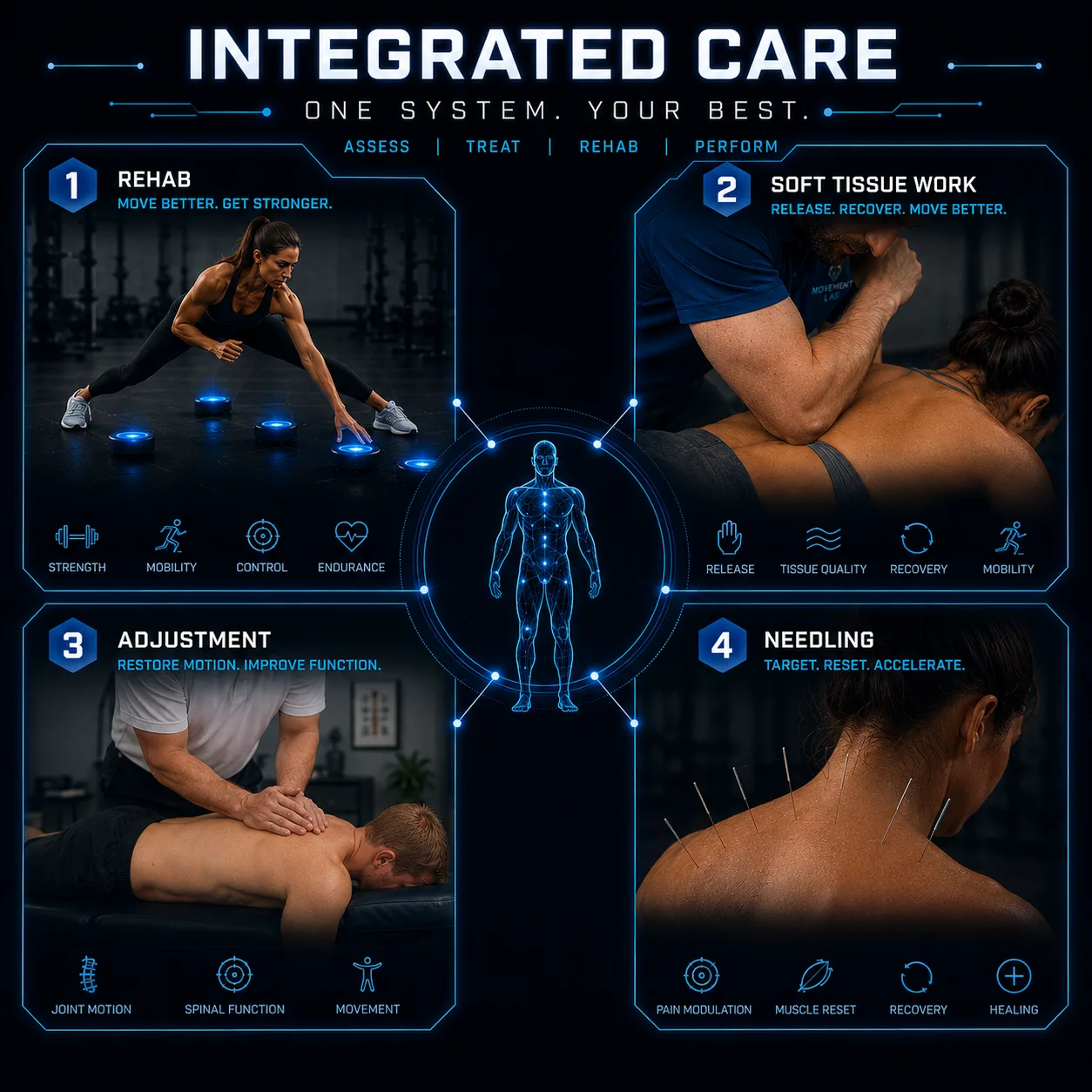
A needle goes where a hand can’t: into one band of muscle or one tendon, at depth, without pressing through everything sitting above it. That precision is the reason it’s here, and it’s also why it only suits a narrow set of problems.
When the body is protecting an area so hard that better movement can’t get started at all.
A tendon that’s still sensitive every time you load it, and needs something more specific than rest alongside the rehab.
A trigger point in one muscle can send pain somewhere else entirely. The needle goes to the source, not to where you feel it.
Commonly treated
The needle looks the same. What guides its placement is different. Acupuncture is grounded in meridian theory and energetic balance. Dry needling is grounded in anatomy and musculoskeletal diagnosis: the needle goes to a specific muscle or tendon based on physical exam findings, with the goal of producing a tissue response in that structure. Different theoretical framework, different clinical indication, different target. If you’ve wondered whether this is the same thing by a different name: it is not.
What it feels like is a quick twitch or a deep ache when the needle finds the target. That’s the signal it got there, not a problem. Mild soreness for a day afterward is normal.
Not everyone wants a needle, and not everything needs one. None of these reach what a needle reaches — working from the outside means going through everything sitting on top of the target. What they give up in depth they make back in how much ground they cover, and for a lot of what walks in here that’s the better trade.
Three things make an area feel tight, and only two of them are ours. The body can be holding it tight on purpose, protecting something it doesn’t trust yet. The tissue itself can have changed, so it genuinely moves less than it did. Or it’s the shape of the joint underneath, and no amount of work on the tissue is going to talk that out of it.
Hands answer the first two. They give a guarding pattern a reason to let go, and they change tissue that has genuinely stiffened. The third one they can’t touch, and chasing it with tissue work is how people end up back on the table every month for years.
Myofascial work run off a map. The Stecco method treats points chosen from the fascial system rather than from where it hurts, so they are often nowhere near the sore spot.
A muscle that has just been asked to contract will let go further than one that hasn’t. PIR uses that: a few seconds of gentle resistance, then the length that follows it.
Often called scraping. A steel tool reaches an area at angles and pressures a hand can’t, which makes it as useful for finding the spot as for working it.
Every other tool here presses down. Cupping pulls up. That is the one input the others can’t reproduce, which is why it is on the list.
Needle or hands, the change has a short shelf life on its own. The area opens up, you go back to the same days and the same loads, and whatever closed it down closes it again. What the treatment buys is a window: a stretch of time where more movement is available to you than there was that morning.
What goes into that window is the rest of the plan. The Movement Model is where the new range gets loaded and repeated until your body stops treating it as unfamiliar. Adjustments layer in the same way, used where the exam calls for it.